Embroidery Fall Flowers Seamless Pattern
A Designer’s Real-World Review for Small Business Merchandise
As an embroidery designer who’s digitized over 2,000 small business assets—from café aprons to pet brand tote bags—I approached Embroidery Fall Flowers Seamless Pattern with a very specific question: Can this work beyond decoration—and actually strengthen brand identity on real merchandise? The answer isn’t just “yes”—it’s “yes, if used intentionally.” This isn’t a generic floral filler. It’s a cohesive, scalable, seasonally resonant asset built for commercial embroidery and branded patch applications.
First Impression: Warm, Handmade, and Professionally Balanced
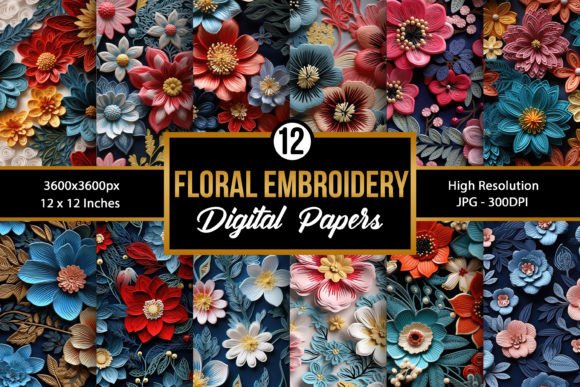
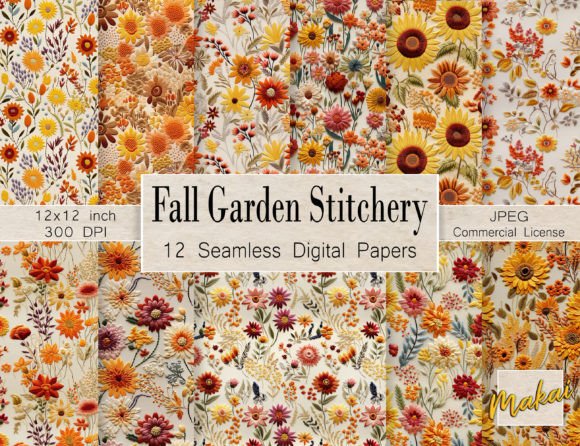
At first glance, Embroidery Fall Flowers Seamless Pattern reads as friendly yet refined—a rare balance for seasonal designs. It avoids clichéd pumpkins or overt harvest motifs, instead leaning into layered chrysanthemums, delicate asters, and soft maple accents that feel organic, not cartoonish. That’s critical for businesses wanting authenticity: a local florist doesn’t need gaudy graphics; a boutique bakery wants warmth, not kitsch. The seamless nature (12 coordinated 12×12” JPEGs at 300 dpi) signals thoughtful design—not just a single motif repeated, but a system built for repeat use across fabric, paper, and sublimation. For embroidery shops, that means flexibility in scaling, cropping, and adapting without losing visual cohesion.
Where It Shines in Real Business Use
Embroidery Fall Flowers Seamless Pattern excels where many seasonal designs fail: versatility without vagueness.
- Embroidered patches: Perfect for back-of-cap logos, sleeve badges, or shop-branded iron-ons. Its balanced negative space and moderate detail hold up well at 2.5–4” sizes—ideal for uniform accents that must read clearly from 6 feet away.
- Apron embroidery & staff uniforms: When stitched along a pocket border or cuff hem, it adds artisanal charm without overwhelming function. The pattern’s rhythm feels intentional—not random—reinforcing professionalism.
- Tote bag design & custom apparel: As a subtle all-over background (digitized with reduced stitch density), it elevates plain cotton to premium handmade product status. Great for Etsy sellers packaging artisan soaps or local honey.
- Product packaging accents & boutique merchandise: Print it on kraft tags, then pair with matching embroidered labels—creating cross-channel consistency between physical goods and digital mockups.
- Cap embroidery & event merch: Cropped tightly, the central cluster works beautifully on front panels. Paired with clean sans-serif lettering, it reads modern—not dated.
Where Caution Is Essential
Even strong design assets have boundaries. With Embroidery Fall Flowers Seamless Pattern, respect these practical limits:
- Avoid under 2” patch sizes: Fine stem lines and overlapping petals may blur or “fill in” during stitching. Always test at your target size before bulk production.
- Curved surfaces (like cap fronts or curved tote handles): Seamless patterns can distort. Digitize with gentle contour compensation—or isolate one floral unit instead of repeating the full tile.
- Dark uniforms or textured fabric: The design relies on tonal variation. On heavy twill or charcoal denim, contrast drops. Boost thread color saturation or simplify outlines in your embroidery file.
- Frequent washing: High stitch density in tight clusters may wear faster. Recommend medium-density fill + satin-stitched borders for longevity on staff aprons or reusable bags.
Brand Identity Impact: More Than Just Pretty
This isn’t decorative fluff—it’s strategic visual language. When a small business uses Embroidery Fall Flowers Seamless Pattern consistently—on staff aprons, customer tote bags, and product tags—it builds recognition through rhythm. Customers begin associating those soft, layered florals with care, seasonality, and craft. That translates directly to trust: a handmade soap brand using it on packaging tells shoppers, “We pay attention to detail.” A café using it on barista aprons says, “We’re rooted in our community—and celebrate its rhythms.” Visually, it supports handmade product positioning without looking amateurish. And because it’s part of the Patterns category—not a standalone logo—it plays well alongside other Graphics, letting you layer it thoughtfully rather than forcing it to carry full brand weight alone.
Practical Embroidery Designer Notes
Before digitizing Embroidery Fall Flowers Seamless Pattern for client work, here’s my checklist:
- Test in black and white first: Does the silhouette read clearly? If stems vanish or petals merge, simplify in your embroidery software.
- Verify scale at intended patch size: Zoom in at 300% in your design program—look for stitch crowding or thin-line breakage.
- Review thread color contrast: Fall palettes (mustard, rust, olive) pop on cream or navy—but mute on black. Adjust thread selection before sending to the machine.
- Inspect spacing between elements: Seamless doesn’t mean “no gaps.” Ensure minimum 0.8mm clearance between adjacent motifs to prevent stitching collisions.
- Confirm hoop size compatibility: While the JPEGs are 3600×3600 pixels, your final machine embroidery design must fit standard hoops (e.g., 4×4”, 5×7”). Crop strategically.
- Test on real fabric: Run a sample on your most common substrate—canvas, twill, or linen—and assess how stabilizer choice affects drape and detail retention.
- Create a printable mockup: Show clients how the pattern integrates into their existing design assets—not as a standalone graphic, but as part of their brand ecosystem.
- Compare beside other assets: Does it harmonize with your current logo, typography, and color palette—or compete with them?
- Confirm commercial licensing: Since this is a digital embroidery file intended for commercial embroidery, verify usage rights cover resale, client projects, and small business merch before purchase.
Bottom line: Embroidery Fall Flowers Seamless Pattern is more than seasonal decor—it’s a functional, brand-forward tool for small business owners serious about cohesive, high-intent merchandise. Used with intention, it doesn’t just look good—it builds recognition, reinforces values, and elevates every finished product it touches.